Showing posts with label Mars. Show all posts

Wednesday, February 25, 2015

Venus and Mars conjunction

You definitely can't miss bright Venus in the western sky just after sunset it is so amazingly bright that it is often misplaced for a coming airplane. It is easy to miss Mars which is a bit below Venus and much dimmer. We have just had another nice conjunction of Venus and Mars.
Why conjunctions are so fascinating? Maybe because it is our way to see that planets really moves, since all other stars are fixed, and just the planets wanders between them. Also such conjunctions are important in astrology but we know all for the better that this is rubbish. the truth is that such conjunction are a pleasure to observe and watch for several days seeing the daily relative movement of the planets.

I've started to track the pair about a month ago when Venus and Mercury were in conjunction and Mars was way above, Last week it rained a lot and I hardly got a chance to photograph the pair. Here is a photo from 19/2/15. Mars is a bit above Venus (You might need to enlarge the photo to see it properly)
 Venus and Mars between the clouds
Venus and Mars between the clouds -19/2/2015
I could not take any photos on Friday 20/2 since I am an orthodox Jew. However it was cloudy and rainy and even as I tried to observe the pair (and the new moon) all that happened was that after a lightning storm I was wet.

Saturday night 21/2/15 the storm was over, the skies were clear and I took the following photos. Venus is extremely bright, Mars is a bit red and their position do look different from the picture above. Also noticeable the nice earth shine on the moon which appears as a while

Venus and Mars 21/2/15
The part of the moon which is not directly lit by the sun still gets some light bounced back from Earth. This light returns to our eyes so we are able to see some details on the entire moon although it is just 3 days old!
A day passed and Venus is already above Mars. Mars is very dim, since there were lots of cirrus clouds in the sky, but you will be able to see it below and to the right of Venus. he moon is much further above
Venus and Mars 22/2/15

Venus and the moon 22/2/15
The conjunction is over. Mars is in its way down to disappear behind the sun. Venus is climbing up to be in a really close conjunction with far far away Neptune (Try to watch is with telescope on the fourth of Mars. Finding Neptune will never be as easy as aiming to Venus) and in July with Jupiter. Planets keep travel in our skies and give us great observations.

For further reading

Sunday, March 18, 2012

Twinkle twinkle little star

We all know that stars twinkles, it is also easy to notice that stars twinkle more when they are low in the skies. The reason for all the twinkles is the Earth's atmosphere and winds which cause it. When the light comes from a star the air refracts it and make it changes in position a bit. Stars are so far always that they seems as a point and even the slightest change will cause them to twinkle. Planets also twinkle but much less since they are small disc and not tiny points (see more details here).

I've learned about a great and simple technique to visualize the twinkling or in the more formal name "Scintillation" of stars. I learned it from Monika Landy-Gyebnar, an Hungarian photographer who found it by mistake when she once accidentally kicker her tripod during star photography. Instead of deleting the photo she notices that the photo looks rather strange.Monika does not sure if she "invented" the method or just "rediscovered" it but the first photos I saw of this method are her.
The technique is quite simple. Take a photograph of a star for about 2 minutes without using a tripod. Look at the result. The stars colors change dramatically. This is the scintillation at work! Do the same for a planet, the brightness might change, but not the color! I was very eager to try for myself. It works. Here is Arcturus.
Arcturus scintillation

I even got a very nice photo for Spica.
Spica scintillation
Spica scintillation
Notice how the color changes as different wavelengths of the light are refracted. For planets it doesn't happen. Here is Mars.
Mars - no scintillation
Thanks Monika for sharing your technique with us!

Friday, February 3, 2012

What is the size of Mars

What is the size of Mars? How big is Mars? The Radius of Mars is 3,389.5 km (About half of the radius of the Earth). Its circumference is 21,344 km (Not a big surprise, this is also about half of the circumference of the Earth). The volume of Mars is 1.63116 X 10¹¹ km3 and the mass of Mars is 6.4169 x 10²³ kg.
Although Mars is smaller than Earth its surface area (38% of earth) Is Almost identical to earth LAND space (Since there are no oceans on Mars).
A common hoax is about the moon and Mars being equal in size. The hoax started back in 2003 when in august 27th Mars was in opposition to earth (Minimal distance) of about 55 Million KM. When Mars was in conjunction with the moon (A planet-moon conjunctions occurs once in a month), the message was that looking at Mars through75X magnification telescope will results in a size similar to a moon. While this is more or less correct, the hoax removed the telescope and the magnification leading people to think that Mars will be as big as the moon to the naked eye. This is of course a complete rubbish. Also the year 2003 was left out and that hoax continues for a year after a year starting mid June and ending After august. Any email that you see with a subject that includes "27th August" is a candidate for the hoax. but don't despair, simply reply with link to this articles and help a little to fight the hoax.
To kill the Hoax completely look at my own photo of Mars and the moon from 24-Dec-2007. There was no occulation (The moon did not cover Mars), but they were extremely close to each other. Mars red color is quite distinctive. You might need to enlarge the photo to see the small disc (It is clear that this is a disc and not a dot of a star) of Mars just under the Moon. Look closely. It is there (around 7 o'clock). Mars was not as close as 55Million KM, but still the difference in size is huge. I took the photo in the early morning. Notice the nice flock of birds to the right.
Mars size
Mars size compared to the moon
Mars distance from Earth varies a lot. The distance can be as short as 55M kilometers or as far as 350M kilometers. During the times that Mars is far, it is quite dim, and its red color almost unnoticeable to the naked eye. It is best to observer it when it is close, and with a good telescope with 100X magnification, you will see many details on it.

Thursday, February 2, 2012

Mars - The red planet

The best visible planet these nights is Mars. Mars is the fourth rock from the sun so it is indeed one of our closest neighbors in space. These nights, while Jupiter is setting early and Saturn rising late, Mars dominates the skies the entire night long. Coincidentally or not, Mars is currently the nearest to the earth that it will be until 2013.

When Mars is so close (Less than 100 Million km) it is very easy to observe. Even for the naked eye it looks very bright and very red.

Mars is currently (3/2012) in Leo (Lion),Using a telescope at this distance, one might observe some details on Mars. Its ice pole (not water ice but CO2 ice) is visible even with small telescopes.

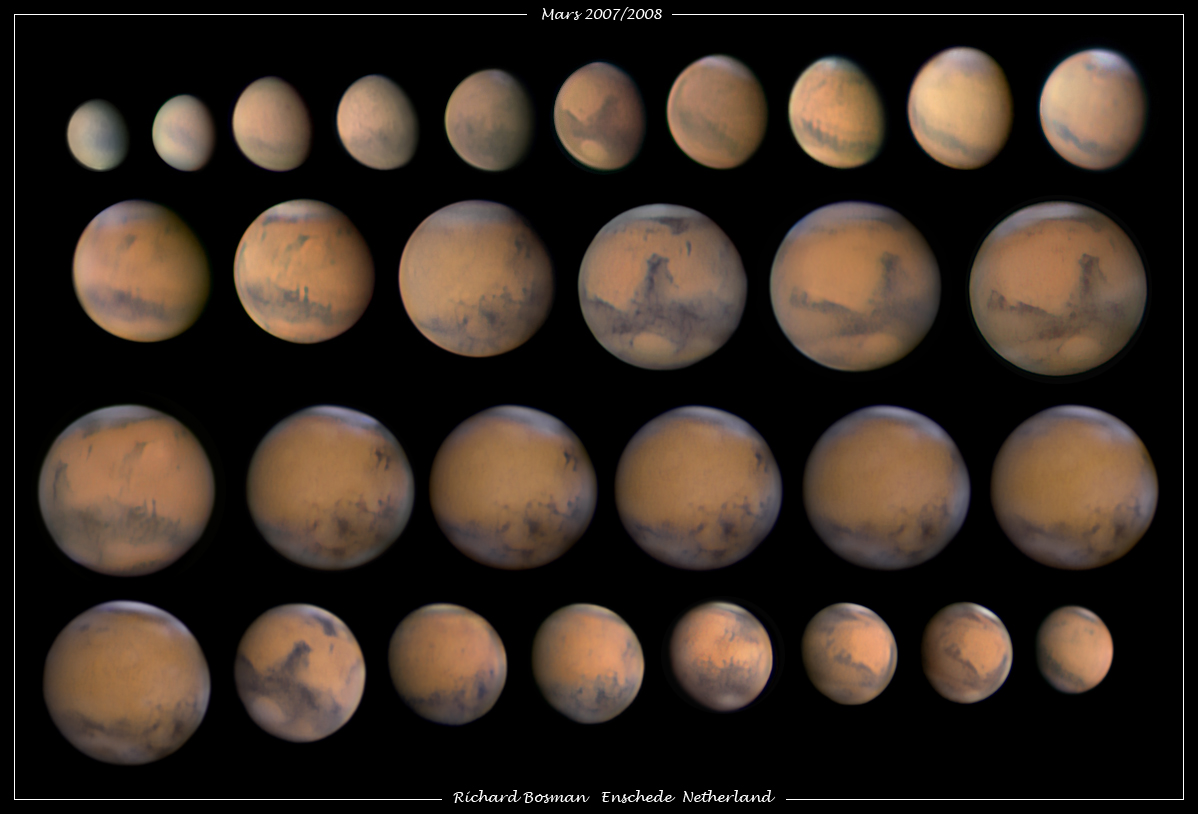
Mars distance (and apparent size) changes dramatically throughout the year. Richard Bosman created a photo which will show this affect.

Mars - Richard Bosman


Retrograde Motion

Even the ancient observers saw the retrograde motion. A planet seems to go slower than usual, then stop and then move in the opposite direction in the skies, then stopped and resume its normal direction. This motion is called retrograde motion and it is cause by the mutual movements of the planet and Earth.

Currently (March 2012) Mars is moving in a retrograde motion. It runs from east to west, which is the opposite direction of the normal motion – towards the east. Mars is getting closer to Regulus and the distance will be only 4 degrees at April 20th 2012. Observe Mars every three days and the motion will be clearly visible.
Mars has a lot of active electronic equipment on its surface. There are two rovers: Spirit and Opportunity. The rovers were planned for 3 months missions but are living for well over 5 years although facing many problems such as stuck wheels and motors, dust storms, long winters etc. Spirit ceased to function but opportunity is still alive. A new rover, Curiosity is on the way to Mars, reaching and landing in August 2012.

The Phoenix probe landed in 2012, and had a successful mission, finding that water ice exists on Mars. The probe is at very north latitude and is not expected to survive the long mar winter (With temperature around -110C). However, scientists at NASA try to listen for any signals form it in case it did manage to survive.

Around mars there are other orbiters, which take fascinating pictures and used for communications from Earth to all things on Mars.

Martian Landscape from NASA

Mars is an attractive location for human settlements. It has an atmosphere with CO2 which theoretically with a little photosynthesis can be turned into a rich Oxygen atmosphere. Deep in Mars there are lots of geothermic energy source, and scientists still looking for evidence of Bacteria or other living things. It is speculated that life started on Mars and only then moved to Earth.

There are some rocks from Mars on Earth. The most famous of them is ALH 94001 (The first rock to be found in the 1994 season in Allan Hills Alaska). That rock did a long way from Mars to Earth and for some time, scientist thought it contains some hints of Martian life.

Last and not least. Mars' color is red since it is rusty! Mars rocks contains large amount of iron which in time got rusty from the little oxygen in the atmosphere. If you anjoy the red color of mars it is not blood, but rust.


Get out and enjoy watching our red neighbor.