Today (Jan 7th 2016) there was a very nice planetary trio. The moon, Venus and Saturn formed an almost equilateral triangle in the early dawn sky. The distance between any pair of celestial bodies was about 2.5 degrees.
All orbs were in the constellation Ophiuchus (Oph). There are only 12 signs in the zodiac but in the modern division of the sky into constellations, it turns out that the sun also travels through Ophiuchus for some days in the year (The moon can be in even more constellations!)
Here are some photos
The trio. Venus is very bright and Saturn is the dimmer star below.
The moon Venus and Saturn
A wide field photo with part of Scorpio constellation in the right side of the photo. You will probably need to enlarge the photo to see it properly, and even see some of the red hue of Antares. Scorpio is a summer constellation and in the winter it rise just shortly before sunrise.
The moon Venus and Saturn
Using longer exposure we can see the Earthshine and many dim stars. You will need to enlarge this as well. Notice HIP81695 which is on the right limb of the moon and two small stars (HIP81632 and HIP81754) above Saturn.
The moon Venus and Saturn
The last photo is on brighter sky just before sunrise.
With all the attention to New Horizons and Pluto lets not forget the veteran spaceship Cassini which makes wonders around Saturn and sometimes it seems as there is an artist photographer sitting there to get these great compositions.
Cassini is now on its 219's Rev around Saturn. The orbit is very elliptical and spans from about 200,000km to over 2,000,000km. Such an orbit is required to measure Saturn's gravitational field and also give chance to flybys around the moons. Each Rev is well planned in advance and is fully using the time to observe Saturn and the moons.
Here are some of the best photos of 2015
You can see many more at Cassini's website and I've added a link for each photo for more explanations and details in that website.
All photos are courtesy of NASA
Lets start with an old photo which is not very familiar. This is a very known object from a completly different angel.
Southern pole of Jupiter: Cassini. NASA
This is an old photo of Jupiter when Cassini passed near him in the previous decade. The angle is unique. Never before we saw Jupiter from down under! The great red spot and the entire clouds' bands are visible in this magnificent image.
What do you see in the following unreal picture? Obviously you see the ring but what is behind the ring? It is the ring shadow in Saturn surface! Cubist art in its best.
Modern art in Saturn's rings
This is moon Rhea. do I see that it also has a heart shape on it or is is my imagination?
Rhea
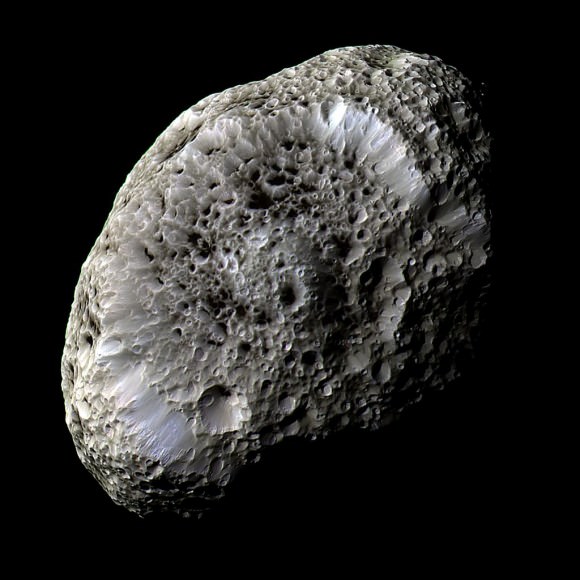
A flying sponge? That's what most people think of Hyperion
Hyperion
And Tethys looks just like the death star from star-wars (Me and the children are eagerly waiting for episode VII!)
Tethys
Dione is beautifully aligned on Saturn ring which is extremely narrow in this photo. The dark silhouette of Saturn is a great background.
Dione
Three moons in one shot and all of them thin crescent. hoe can that happen?
Titan Mimas and Rhea
Who's who? The large object is Saturn! look carefully for the thin ring in the right middle. The small object is Titan which is a very large moon but small in front of giant Saturn.
The Cassini spaceship is orbiting Saturn for many year now and always manage to amaze. On the 19th of July Cassini will take a photograph of planet earth while Saturn blocks the sun. This will be a reproduction of the iconic photo from 2006 and a good chance to compare and see any difference. You can watch the 2006 photo in the following article together with many more photos of earth from space.
To celebrate the event I've collected some of the best photos of Cassini from 2012-2013. There many more and it is hard to choose from. Enjoy! Credit to all photographs is to NASA.
Saturn and Titan
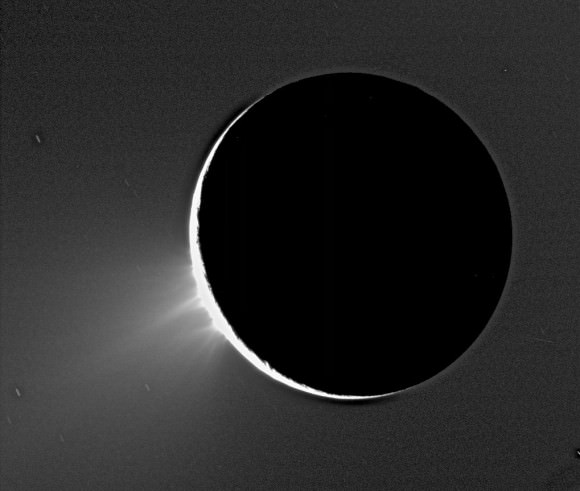
Enceladus looks like a popped balloon.
Enceladus
A huge storm on Saturn
A huge storm on Saturn
A closeup of Enceladus. Jets of gases are vaporizing into outer space
A closeup of Enceladus
Two tiny moons: Prometheus and Pandora
Prometheus and Pandora
The surface of the moon Rhea. Rhea is one of the moons that can be seen with even a small telescope from earth.
Rhea
Is this river Nile? Might be an old river on the surface of Titan
Saturn in the dark. Saturn covers the Sun, but the rings are lighted and reflect light back on Saturn which gives an extraordinary result.
Saturn in the dark
Saturn
Saturn
Saturn shading its rings. Notice some tiny dot and the upper left area - a tiny moon.
Saturn shading its rings
This photo is the first photo of meteors not from Earth. Read more about these meteors.
Meteors striking Saturn
This is not Saturn. This is Titan with little moon Dione with the rings as a background.
Titan with little moon Dione
A vortex on Titan
A vortex on Titan
And from another angle
A vortex on Titan
And a closeup
A vortex on Titan
Saturn is blocking the sun. At the upper left a small dot. This is not Earth but Venus.
Venus from Saturn
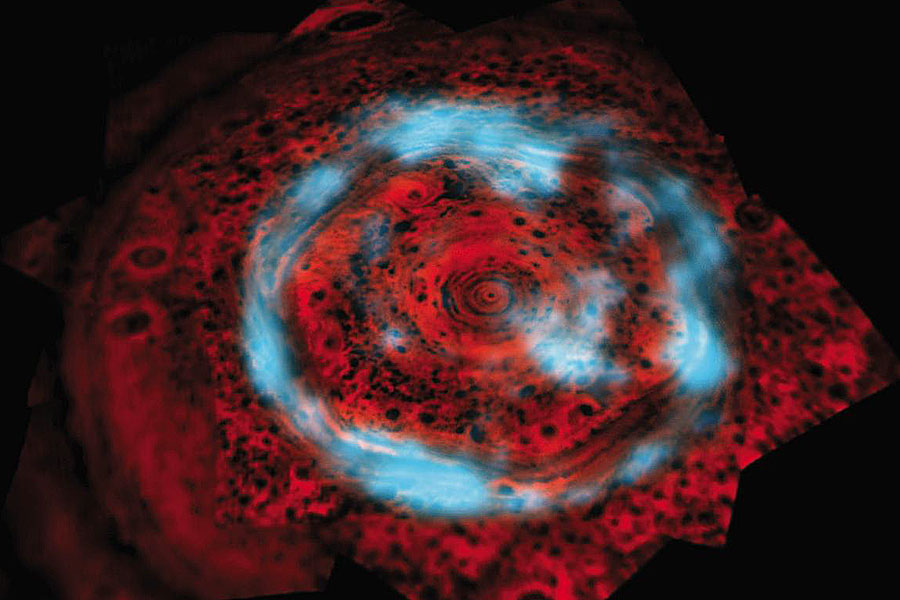
Strange things happens on Saturn's north pole
Saturn's north pole
You probably remember the incredible transit of Venus (well the whole site started from it). Anyway this is a Venus transit from Saturn. Read more here.
Cassini is a spaceship orbiting around Saturn sine 2004 and at least until 2017. Cassini left earth in October 1997 with the European Space Agency's
Huygens probe. The probe was equipped with instruments to study
Titan, Saturn's largest moon. It landed on Titan's surface on Jan. 14,
2005, and returned spectacular results. Cassini finished its primary mission but since the spaceship is functional the missions was extended at least until 2017.
This article will present several of Cassini's best photos. There are thousands of greats photo and new are acquired every day. for some of the photo it seems like an artist photographer aimed the spaceship's cameras to get the composition. Enjoy the results and keep checking for great new Cassini's photos.
The first photo will give a full portrait of Saturn. This is an old photo from 2005. This is not a single photo, it is a mosaic of 126 taken over 2 hours from 6.3 million km (4 million miles). A full resolution version of this photo is here
Saturn (2005): Cassini NASA JPL
Saturn rings cut Titan just like Chinese's chop-sticks. Below the smaller moon Mimas. Only the edge of the rings is visible. the center of the rings is in Saturn's shadow!
Saturn's rings, Titan and Mimas. Credit: NASA
This is an amazing photo showing the dwarf moon Daphnis (Its diameter is only 8km) which orbits in the ring. The small gravitational effects of the little moon on the rings is quite visible!
Daphnis between Saturn's rings NASA JPL
The next photo shows the shadow of Titan (diameter: 5150km ) on Saturn. If you happen to be in that shadow you would see a total solar eclipse. The rings face the sun, so their shadow looks very thin.
Titan's shadow on Saturn NASA JPL
Small moon Pan travels between the rings in the Enkce gap. You will need to take a good look at the photo. Pan is not the moon in the bottom of it (the moon at the bottom is Janus) . It is in the middle and it shed a long shadow over the rings.
Pan shadow on Saturn's rings NASA JPL
Now for a game of who is who. Two moons (Dione and Rhea) are attache to each other? well no, the distance between the moons is 500,000km, but the timing makes them looks like they go one over another
Dione and Rhea together NASA JPL
There are also videos (Cassini's does not have a video camera, the video was created from a series of photos). This video shows Saturn's Aurora in Infrared light.
A closeup of Titan. From time to time, Cassini's has opportunities for flybys, a very close approaches to Saturn's moons from time to time.
Clouds on titan. NASA JPL
What happened to Hyperion that gave it this unusual shape?
Hyperion. NASA JPL
The moon Enceladus is another strange moon. It has lots of activity on it, including geysers which erupts jet streams to the space.
Saturn's moon Enceladus
Surface of Enceladus
Surface of Enceladus
Saturn's rings are very thin. Mostly their thickness is just 10 meter! but from time to time there are mountains in the rings. look for them in the next photo and see that these mountains (up to 2500 meters) cast long shades on the rings' plane)
Saturn's rings
Saturn's rings are dynamic. The ring are composote from millions small particles and they change constantly.
Dione from 115,000 km
There are more great photos and more will come in the future. All photos are taken from CICLOPS - Cassini Imaging Central Labortary for Operations
Which includes photos from the last decade and even before Cassini arrived Saturn (take a look for Jupiter photos!)
Many observers consider Saturn to be the most spectacular planet. Its magnificent rings, seen clearly with even small telescopes, provides Saturn a great for over other planets such as Jupiter with its clouds or Mars and its surface features. Saturn is the sixth planet in the solar system and is the furthest away from the sun that we can see with the naked eye.
For the ancients, Saturn was the seventh and last planet. The list included the sun and moon as planets and the Earth was not included. Uranus, though may be seen with the unaided eye was not considered to be a planet in ancient times since it is too faint and moves very slowly. For these reasons Saturn had the honor to be the last planet.
Saturn's movement is slow, completing its orbit around the sun every 30 years. To see Saturn movement in the sky you should watch it every two weeks. At this duration its movement will be noticeable. Currently (May 2012) Saturn is in Virgo near the bright star Spica. Using Spica as a reference fixed star will help to identify the slight movement of Saturn.Saturn is the second largest planet, however its mass is not high (relatively) and its density is only 0.7 (g/cm2) which means that Saturn will float in a very (very) big ocean just like wood.
General information on Saturn (from Wikipedia)
Saturn information
Saturn orbit
Mean distance from sun
1,426,725,413 km
(9.537,070,32 AU)
Orbit time
10,832.327 days (29.657296 years)
Axis tilt
2.488°
Number of moons
60 and some more which are not named yet
Physical attributes
Radius
60,268 Km
Surface area:
4.27×10¹⁰ Sq. KM
Mass:
5.6846×1026 Kg
Density:
0.6873 g/cm2
Gravity:
8.96 m/sec2,
or 0.914 g
Rotation period:
10 hours, 47 minutes, 6 second
Rotation speed:
9.87 Km/Sec (Equator)
Rotation Axis tilt:
26.73°
Escape velocity:
35.49 Km/sec
Atmosphere
Pressure:
140 K Pascal
Hydrogen
More than-93%
Helium
More than-5%
Methane
0.2%
Water vapor
0.1%
Ammonia
0.01%
Ethane
0.0005%
Saturn was one of the planets that Galileo watched with his telescope in 1610. Galileo's telescope was not sharp enough and Galileo did not see the rings very well. Galileo saw something like two ears, and that is how he draw it.
Saturn in a draw by Galileo
After some years the ears (rings) disappeared and then re-appeared. The reason for this is that the rings plane was parallel to the earth and although the rings are large, there thickness (height) is just about 10 meters. Look from a distance on a sheet of paper with its narrow thin edge toward you, and you will hardly see it. Turn the paper toward you and you will see it clearly. It is the same with the rings which becomes invisible when they face exactly toward earth. The cycle of the rings plane movement is 14 years. After some years Galileo draw the rings of Saturn again, in a way which is more similar to what we usually see.
Saturn in a draw by Galileo
Only when telescopes were improved the fine details of the rings were discovered. The origin of the rings is unknown but the best theory is that an old icy moon of Saturn was crashed to millions of small pieces. The real beauty of the rings was discovered only when Pioneer and then Voyager came close enough to Saturn during the late seventies and early eighties.
Saturn from Pioneer 11. Credit: NASA
Voyager images were much better. The next photo from Voyager 2 taken 21 Million KM from Saturn and shows 3 of its moons.
Saturn from Voyager 2. Credit: Nasa
These days Cassini is orbiting Saturn sending even more amazing photos. We will dedicate Cassini a special article next week.