Sunday, January 8, 2012

The movement of the planets

What are planets? Planets are moving stars. While most of the stars are fixed in the sky rotating as a whole unit and never changes their location relative to each other, the planets are different and may appear in different places in the sky, not the whole sky but rather a thin band which is called the Zodiac. From very ancient times, people notice that there are 7 stars which move, and the Greeks called them planets (which mean wanderers). These ancient 7 "classical planets" were the Sun, the Moon, Mercury, Venus, Mars, Jupiter and Saturn. Earth of course was in the middle of the universe, still and not moving, and Uranus and Neptune too faint to see.
Today there is a formal definition of planets, There are exp-planets (Planets orbiting stars other than the sun), and many planets has planets of their own (moons). However, Planet is still moving in the sky and it is very easy to observe this movement with your own eye just like our ancient predecessor thousands of years ago.
To observer the movement of the planets you will need to identify them. It is not hard since planets are quite bright, being easily noticed in the sky (especially Venus and Jupiter), and also because they are not part of any constellations in the zodiac. If you have troubles try using software such as stellarium or applications for you iPhone or Androids mobile devices. In order to see the movement you will have to choose a reference start, a bright star which is close to the planet and you can measure the distance between them.
The planets which are closest to the sun, Mercury and Venus are moving fast. However Mercury is hard to find so leave it alone. Jupiter and Saturn moves slow so it takes at least two weeks between observations to see noticeable change.
The following photos present Jupiter and Mercury near one of their conjunctions. I used Jupiter as a reference star to demonstrate the movement of Mercury. Jupiter is also moving but in a period of 5 days its movement is negligible. Let's start with the photos. Jupiter is always the left dot and mercury is seen much below it.
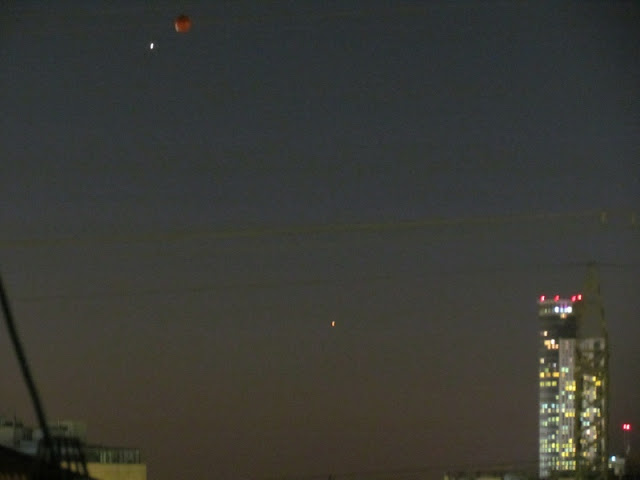
Jupiter and Mercury
Jupiter and Mercury day 1

After a day Merucry is still below Jupiter.
Jupiter and Mercury
Jupiter and Mercury day2

After another day, Merucry and Jupiter are almost at the same height. The photo was taken in twillight so it may be hard to see both planets which appears as pale white dot. Try to enlrage the photo to see better.
Jupiter and Mercury
Jupiter and Mercury day3

After another day Mercury is higher than Jupiter.
Jupiter and Mercury
Jupiter and Mercury day4

And after another day, Mercury is much higher than Jupiter.
Jupiter and Mercury
Jupiter and Mercury day 5
After another day Mercury and Jupiter were too far to take a photo together.

Thursday, January 5, 2012

How I killed Pluto - Mike Brown

If you are older than 15, you probably learned at school that the solar system includes 9 planets. This was not always the case. In ancient times there were only seven. Seven is a good number. It is a meaningful number as there are seven days in a week. Earth was the center of the world and did not count while the Sun and the Moon did. During and after the Copernican revolution the number changed quite often. Earth become a planet but the sun and moon were deleted from the list. Then came William Herschel and discovered Uranus, then came Adams, Leverrier and Galle predicting and finding Neptune. Meanwhile more large objects were found in what's now called "The Asteroids' belt" (Ceres, Palas, Juno, Vesta) and for some time they were also counted as planets and finally Clyde Tombaugh found Pluto in 1930 making a nice (but meaningless) number of 9 Planets. Then come Mike Brown and on his pursuit to find  the tenth planet actually killed the ninth.
Mike Brown's story is detailed in his book "How I killed Pluto and why it had it coming". Well Pluto is not to blame for anything. It is just there, but Mike managed to write a story which is a great mix of: history, biography, science, philosophy and even a thriller. A thriller you might ask? Yes, chapter nine is written as a thriller and describes how private observational data was exposed on the Internet and might have been used by other researchers to get first credit for Mike's discovery (I can't resist to compare this case to James Watson and  Francis Crick who used Rosalind Franklin's data without her knowing about it to get the breakthrough they needed in their DNA research). In this chapter you will also read Mike's philosophical thoughts about science, why and when some observations must be kept secret, and why others must not.
The story reaches its climax when the International Astronomical Union (IAU), in 2006, decided what is a planet (and thus deciding if Mike discovered new planets or the opposite, reduced the number of planets by removing Pluto), and although Mike had much more to gain as a planet discoverer, he strongly felt that Pluto should not be a planet. If you need someone to blame for Pluto's fate, Mike is a good choice, and occasionally he gets a number of complaints on this issue. However, even though Pluto is not a planet, it is still important, as the rest of the distant objects out there, since their existence requires new theories about the creation of the solar system itself and Mike relates to this subject throughout the book.
As you read, you will enjoy the story, as it goes from Mike's early childhood to that of his daughter, Lilah. You do not have to be an astronomer to enjoy the book (although it helps). However, as an amateur astronomer I liked the fact that Mike is also an observer. Mike isn't just a researcher, looking through telescopes (and the biggest ones - Keck and Hubble)  and at thousands of pictures of the sky to find new planets (sorry, not planets but "dwarf planets"!). Throughout the book Mike shows us what it is to observe, he describes how much he loves to watch the moon and the planets. The book ends with Mike describing the conjunction of Venus Jupiter and the moon. It happens from time to time and I remember hosting a star party to share this experience with people from my community. Also, Mike gives a good explanation about naming the new objects he finds, and although the meaning of Haumea, Makemake, Eris and Sedna is known and written in many places, the reasoning behind giving these names is detailed in the book.

Mike's Internet site

Mike's video lecture about how he killed Pluto 

How I Killed Pluto and Why It Had It Coming


Saturday, December 10, 2011

The history of Venus transit

Venus transits occurred throughout history. It is not known however, if someone actually saw such a transit before 1639. It is possible to see the transit with the naked eye if the sun is rising or setting, or if there is a hazy dusty air. It is probable that someone in the early past saw it. The first modern astronomer who calculated the transits was Kepler who predicted  the transit of 1631. Sadly, Kepler's predictions were not accurate enough, the transit was invisible from Europe and no one saw it. Kepler predicted the next transit to be only in 1761. However, a very young English astronomer, Jeremiah Horrocks, calculated from Kepler's Rudolphine Tables, that a transit should happen on the 24th of November, 1639. Sadly, Horrocks reached this conclusion less than a month before the transit. The transit was fully visible from America, but there was no time to send a message to the new colonies. So the first observation of a Venus transit was by only 5 people. Horrocks himself and his colleague William Crabtree and together with Crabtree's family we reach a count of 5 people in all. Horrocks and Crabtree utilized the transit to measure Venus's apparent size compared to the size of the sun and used this data to estimate the distance to the sun. Horrocks was among the first to see that the universe is much larger than ever thought before and estimated the earth-sun distance to be 100 Million kilometers. Although this value is still 50% wrong, it was 4.5 times more than the value Kepler gave, and more or less within the correct magnitude.
Horrocks was the first significant English astronomer and he is often called the Father of British Astronomy. He was both a great observer and a great theoretician, a rare combination, suppressing Tycho Brahe, Copernicus, Kepler and Galileo. Sadly, Horrocks died unexpectedly (the reason of his death is unknown) at the young age of 22.
The next pair of transits were in the years 1761-1769. The measurements and calculations from these transits were used to more accurately determine the distance between the Earth and the sun which by than was called Astronomical Unit (AU). Observations were made from many places, the most famous was in Tahiti by no less than the legendary Captain Cook.  From these observations, a better value which is very similar to the present value was calculated.
The next pair was in 1874 and 1882, and gave another chance to refine the AU distance.
The last transit was in 2004, a marvel to watch, and now we are waiting for the 2012 transit, not to be repeated again before 2117.
Jeremiah Horrocks observing the Venus Transit
Jeremiah Horrocks observing the Venus Transit by Eyre Crowe. The painting name is The founder of English Astronomy. Painted in 1891

For further reading please refer to the following Venus Transits books.
Historical observation data can be found here.

Monday, December 5, 2011

Books about The Transit of Venus

There are several books which deals promptly with the Transit of Venus since its first observation in 1639 and till our days. I will recommend several books about the transit. While the topic is covered in short in many astronomy books, reading a book which is dedicated to the phenomena is more satisfying.

The transit of Venus by Wiliam Sheehan deals with the scientifc importance of the transits. In this unique and fascinating history of science, acclaimed popular science writer William Sheehan and award-winning geographer John Westfall take us back through the centuries to chronicle the intrepid explorations of scientists and adventurers who studied the transits of Venus in the quest for scientific understanding. In exquisite prose, the authors begin their true tale with the first telescopically observable transit in 1639, when Copernicus's vision of the solar system was just gaining acceptance. This "Earth-shattering" observation was of monumental importance, because it helped confirm that the planets, including Earth, revolved around the Sun, and not the reverse as had heretofore been believed. Sheehan and Westfall take us on a journey through time vividly evoking the excitement and adventures of explorers and scientists who braved the elements, wars, and disease to follow the transits of the past. Some succumbed to an early grave. Others were victorious in capturing those precious, fleeting moments when Venus cast its shadow on the Sun. From the courageous voyage of Captain James Cook through later breath-taking adventures to the upcoming 2012 transit (the book includes information about the upcoming 2004 transit which is long past for us), this uniquely invaluable tome will provide a history and a guide for the future on the unparalleled beauty and meaning of experiencing a transit of Venus. Complete with maps showing both historical and contemporary observation points, plus tables of visibility conditions for major cities, this eloquent story of a timeless phenomenon will enchant readers of all ages.
The transit of Venus by Peter Aughton deals with the life of Jeremiah Horrocks which was an early English astronomer, and never really got the fame he is deserves. Horrocks was the first to observe a Venus transit, so viewing the Venus transit 2012, will actually means to continue his way! There is a missing chapter in the history of astronomy--between the work of Galileo and Newton--and it is a chapter that belongs to England. In the period before the English Civil War, Horrocks was the greatest astronomer in the kingdom. He knew the positions and motions of the planets more accurately than any person of his time, and was the first to appreciate the true scale of the solar system and formulate a valid theory for the wanderings of the moon. Yet he was not an elderly grey-bearded sage, but a young man living in provincial obscurity, who on his death had barely come of age but who left a great scientific legacy.
Peter Adds approach to the subject is slightly different and he discussed the influence of the transit, the fact that the Venus transits in the 18th centuries were simultaneously observed to measure our distance from the sun, and actually revealing once more how large is the universe. Going beyond the science of astronomy, this study looks at the history of Venus' rare passings across the face of the sun which have affected the exploration, colonization, and science of our planet for thousands of years. In response to Venus' 2004 transit, the first in 121 years, the scientists and historians in this study look at the extraordinary impact these astronomical events have had on our culture throughout history, and look ahead to the next transit in 2012.