Friday, July 12, 2013

Cassini's images

The Cassini spaceship is orbiting Saturn for many year now and always manage to amaze. On the 19th of July Cassini will take a photograph of planet earth while Saturn blocks the sun. This will be a reproduction of the iconic photo from 2006 and a good chance to compare and see any difference. You can watch the 2006 photo in the following article together with many more photos of earth from space.
To celebrate the event I've collected some of the best photos of Cassini from 2012-2013. There many more and it is hard to choose from. Enjoy! Credit to all photographs is to NASA.


Saturn and Titan
Saturn and Titan

Enceladus looks like a popped balloon.

Enceladus
Enceladus

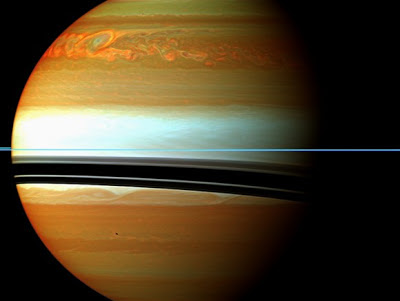
A huge storm on Saturn

A huge storm on Saturn

A closeup of Enceladus. Jets of gases are vaporizing into outer space

A closeup of Enceledus
A closeup of Enceladus

Two tiny moons: Prometheus and Pandora

Prometheus and Pandora


The surface of the moon Rhea. Rhea is one of the moons that can be seen with even a small telescope from earth.
Rhea
Rhea


Is this river Nile? Might be an old river on the surface of Titan

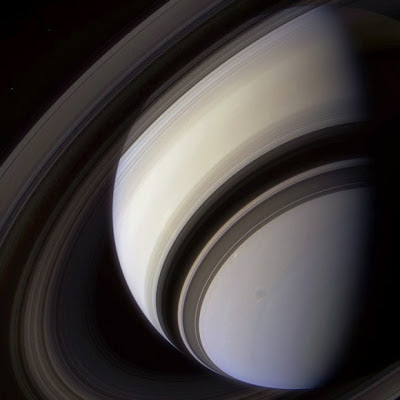
Saturn in the dark. Saturn covers the Sun, but the rings are lighted and reflect light back on Saturn which gives an extraordinary result.

Saturn in the dark
Saturn in the dark


שבתאי
Saturn


שבתאי
Saturn

Saturn shading its rings. Notice some tiny dot and the upper left area - a tiny moon.

Saturn shading its rings

This photo is the first photo of meteors not from Earth. Read more about these meteors.
Meteors striking Saturn

This is not Saturn. This is Titan with little moon Dione with the rings as a background.

Titan with little moon Dione

A vortex on Titan

A vortex on Titan
A vortex on Titan


And from another angle
A vortex on Titan
A vortex on Titan


And a closeup
A vortex on Titan
A vortex on Titan

Saturn is blocking the sun. At the upper left a small dot. This is not Earth but Venus.

Venus from Saturn
Venus from Saturn

Strange things happens on Saturn's north pole
Saturn's north pole
Saturn's north pole
You probably remember the incredible transit of Venus (well the whole site started from it). Anyway this is a Venus transit from Saturn. Read more here.

Venus transit from Saturn
For further reading:
Saturn
More images from Cassini

Saturday, July 6, 2013

Israel first satellite

Shavit 2 was the first satellite that Israel launched to space. The rocket launched on July 5th 1961 and Israel joined the distinguished "space club" a very short list of countries who are able to develop, build and launch a satellite by their own means ( in 1961 there were only 6 countries in the "club" : US, USSR, UK, Japan, Italy, France). The rocket itself was a very simple rocket with some instruments for meteorological research. the rocket was very small, but to make it look much bigger it was put on a high stand and photographed from a very low angel to look like one of the big American rockets. In fact its length was just about 4 meter.

Many of Israel VIP attended the historical launch. The prime minister and secretary of defnse, David Ben Gurion, his deputy Shimon Peres (Current presiodent of Israel) , Zvi Zur, Brigadir General and more.

History is funny as the only country to congratulate Israel for its achievement was Turkey. Nor the white house, neither the Kremlin (And the times were the hot days of the cold war) gave any official response.

 Shavit 2
Replica of Shavit 2 actual size: Photographed by: Tal Inbar
Israel ministry of Defense recently relieved the following video. Notice how big the rocket looks in the film (remember that the lower part is just a stand, not a real phase). The video is without sound so the usual roar of the launch is not heard. David Ben Gurion, hearing explanations and you might recognize Peres and Rabin in the film as well. 
The launch was a very important achievement for the new state of Israel only 13 years old.


Monday, May 20, 2013

Jupiter Venus and Mercury

An interesting stellar conjunction is about to happen, starting from 20th of may until the 27th of May 2013. Jupiter, Venus and Mercury will be close to each other in the west, immediately after sunset.
Conjunction between two planets are very common and even between three planets are not rare. Conjunction are always a nice sight to watch and no equipment is needed. Look here for photos of a previous conjunction between Jupiter and Venus and try to think of a great photographs opportunists near your house.


This is what you will see on May 21st. Mercury is only 5 degrees above the horizon and Jupiter is 13. Jupiter is going down and down and Venus and Mercury up. Watch for several nights to see how the planets move.
Jupiter Venus and Mercury May 21st 2013
And here is a real photo from 22-May-2013. Jupiter is in the top, Venus and Mercury in the bottom.
Jupiter Venus and Mercury 22-May-2013


This is the planets position on May 26yh. Mercury is now the highest of the planets.

Jupiter Venus and Mercury May 26th 2013
Jupiter Venus and Mercury May 21st 2013
And a real photo taken by my dear wife Rosalind Eidelheit. As you can see, Rosalind was very lucky to find some seconds with all three planets visible with these many clouds!
Jupiter Venus and Mercury May 26th 2013
And just one day after. Much less clouds!
Jupiter Venus and Mercury May 27th 2013
And another one from the 28th. I like the power lines which look like a musical score - a celestial symphony
Jupiter Venus and Mercury May 28th 2013

Jupiter will continue to go down until it will disappear from the evening sky and become a morning start, while Venus is about to dominate them for the coming months.

Tuesday, May 14, 2013

Carnival of space #301

Welcome to another edition of Carnival of Space! And in this issue we have the following articles


From The Chandra telescope - There are just too many things over our heads so actions are required in order to avoid collisions in space

From Here,There and Everywhere we learn that not all lightnings are equal. Ever heard of "dark lightnings"?

From the Meridian journal we learn about new discussion of a manned Mars mission by 2030.

From Nextbigfuture - Ohio State University has performed some computational studies of molten salt reactors for NASA space applications.They looked at 4 MW thermal and 60 MW thermal reactors and flow dynamics and basic design. Molten salt reactors are an appealing technology for space because of their high temperature and low pressure operation, controllability, and high fuel burn up, among other features.

Also from Nextbigfuture - Northop Grumman completed a lunar lander study for Golden Spike.

And the last piece from Nextbigfuture- Spacex Grasshopper moved to New Mexico so it can fly higher and farther

Everyday Spacer - What Would You Do With a Million Dollars? Please give this some serious thought because it could happen to you! If it does, you will either be prepared to tell someone what you will do with the money or you will not. If it happens, who do you think will get that reward?

And another one from Everyday spacer: Around Town, End of May 2013 Around Town posts feature ‘quickie’ notes about activities that you can do locally or online. We want to let you know about as many different things out there that you can do – often, right where you are – and sometimes just for taking the time to go look. Remember… It’s all about action!

It is impossible to end this carnival of week with the expensive cover versions ever recorded. Chris Hadfield recorded a cover for the famous David Bowie hit: "Space Oddity". Words somewhat changes and there are not two voices, but that is a great tribute to summarize Chris's 5 months in the ISS. Read more about the recording on Universe Today (who neglected to send an article, but I add anyway and hope they don't mind).

My personal opinion is that the ISS is a highly costs project with limited benefits and that its part in NASA budget is too large. As much as I like the cool movies from there I do wonder, is there a purpose for that huge giant structure in space? It started over 20 years ago, and it seems that now we are facing the question: "What to do with it?". IMHO, funding more planetary missions will give more value of NASA budget". What do you think?