Nothing but a very big WOW. The Venus transit in Israel was visible on June 6th from sunrise to external egress, a little more than 2 hours. I had to wait until all my US friends saw it and went to sleep. I was very worried about clouds and hardly slept at night. At 5am the skies were cloudy but not very, so I was confident that even if I miss sunrise (because of the clouds) they would disperse later on and it would be OK. I started the observation with the almost full moon in the west.
Almost Full Moon
After that I climbed to the roof of a tall building and saw that the entire east was covered with clouds... Not so good...
Cloudy East
But two minutes later, an area in the sky became brighter, that was the sun, so I aimed my camera quickly and grabbed this photo. At this point, I couldn't see anything with my eyes or use a filter, but the moment that I saw on the camera screen that there was a big black dot on the sun I was extremely happy. A complete round sun with a dot is nice but a very ordinary photo. The following photo is anything but ordinary. The rising sun in a deep purple color, the clouds below and above the sun, the buildings in front and the buildings through the sun, and of course, Venus - a composition that will not be repeated for another 105 years!
Venus transit at sunrise
Here is a close-up of the Sun, the buildings are seen clearly, and it looks like sci-fi...
Venus transit at sunrise
A few minutes afterwards and the disc of the sun passed through the first layer of clouds. This photo is still without a filter and it shows Venus, distorted by the heavy Earth atmosphere (the sun is still very low in the sky), and another surprise - one of the several sunspots! The photos of the rising sun were great but I still had to set up my observation.
Venus transit at sunrise
For me, astronomy is not just a hobby but a passion I like to share with others. I set up a public observation in my town, and after seeing the sunrise I quickly went to the place where I planned the observation and setup the telescope. People started to come at around 6am. They looked at the sun through the telescope and through the eclipse's sunglasses, received information and explanations about what they saw and took photos through the telescope or through my filters.
Venus transit observation at Givat Shmuel Israel
After that I photographed ordinary photos of the whole sun through a solar filter. Many sunspots are visible as well.
Venus Transit
The event slowly came to an end. The next photo shows the internal egress, when Venus touches the limb of the sun from the inside. For another 20 minutes or so Venus exited the sun completely becoming a morning star.
Venus transit internal egress
The observation took about 2 hours, and about 100 people, young and old, male and female took part in it. It was great fun and a rare experience and I am very happy I took a part in it.
To finish, here is a short video of the sun rising.
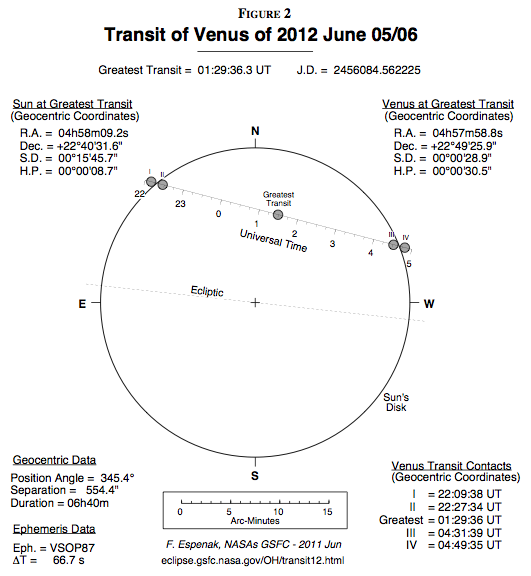
There are five timing points for the event:
External Ingress - Venus first touches the limb of the sun. The transit begins - 22:09:38 UT
Internal Ingress - The first moment that all of Venus is in front of the sun - the full transit begins - 22:27:34 UT
Greatest Transit - The exact middle of the transit. Venus is at its smallest distance from the sun center - 01:29:36 UT
Internal Egress - the last moment that all of Venus is in front of the sun - 04:31:39 UT
External Egress - the last moment that Venus partially blocks the sun. The transits ends (for the next 105 years!) - 04:49:35 UT
You can use this application to locate your exact time (Taken from the following superb site which also deals with Venus transit)
Transit times
You can also use the following Time table (from NASA). The times are give in UT (Universal Time), you will need to add or
subtract hours from UT according to your timezone and your daylight
savings time (most northern countries will have daylight time in June, southern countries will not).
US Major cities timetable for Venus Transit:(Times are in UT)
You will see that the US will have the transit on the 5th of June 2012, and will be able
to see only the beginning of it (except Hawaii)
                   ------------------- T r a n s i t   C o n t a c t s -------------------

Location Name       External Sun   Internal Sun   Greatest Sun   Internal Sun   External Sun
                    Ingress  Alt   Ingress  Alt   Transit  Alt    Egress  Alt    Egress  Alt
                     h  m  s  °     h  m  s  °     h  m  s  °     h  m  s  °     h  m  s °
Major International cities Venus transit timetable (NASA)
All times are in UT and must be adjusted to the local time
Read more about Venus Transit at the Venus transit FAQ page
Entire Europe, Middle East and West Asia will see the transit on 6th June 2012. Most sites will only see the final phase of the transit after sunrise.
Viewing the Venus Transit requires special preparations. The transit is on the face of the sun, so direct viewing is impossible. Remember that direct viewing of the sun with the eyes is dangerous and doing it with an optical aid such as binoculars or a telescope may cause permanent damage and blindness. Do not use improvisations such as old floppy disks, old films etc.
The instructions are also suitable for a Solar eclipse observations.
After this warning here are some options to view the Venus transit.
Solar Eclipse Glasses
Get special solar eclipse glasses. These are special glasses, with special filters which block almost 99.99% of the sun light. Such glasses are not expensive, and will be very useful for future solar eclipses (there will be a full solar eclipse in 2017 in the USA). However, such glasses are to be used with the eyes only, and not through a telescope or binoculars!
If you have a telescope you might want to consider to purchase a Solar Telescope Filter for it. There are generic filters which are suitable for many telescopes and there are vendor specifics filters for the vendor brands. You can buy at Amazon or at your local dealer. These filters are attached to the telescope, in front of it and block the light BEFORE it enters the telescope. Such filters MUST NOT be used instead of an eyepiece. The light from the sun must be blocked before it is concentrated by the telescope (the filter is not strong enough to block the light after the telescope concentrates it). During the observations make sure that the filter is strongly attached and that no one removes it by mistake (especially when you are doing an observation with a group of people).
If you are really into solar viewing, you should consider purchasing a dedicated solar telescope. Such telescopes as the Coronado PST are dedicated and safe for solar viewing and are useful to observe other interesting solar phenomena such as the sun prominence.
If you have a telescope and you want to project the image to a large audience you can use the projection method. Basically you project the image of the Sun to a dark surface (make it in the shade) and focus. Sunspots are very visible this way. This method is appropriate for small refractors and Newtonian telescopes, but not for SCT telescopes. If you are not sure how to do it or if it is suitable for your telescope do not do it! Personally, I do not like this method very much since I think that if you already have a telescope, it is a very little investment to buy the filter. Take note that the intensity of the sun light may harm the telescope as it creates heat which can harm the plastic and the optics so do it at your own risk. Also make sure that no-one ever tries to look through the telescope at the sun. Full instructions are here
You actually don't have to own a telescope to project the sun. You can build a great homemade pinhole projector from simple boxes. You will get a small image of the sun and you will be able to see a dark spot on it.
If you do not have the solar glasses nor a telescope, join your local astronomy club. The transit is a major event and professional observatory and local amateur groups will provide the means for the public to view the transit.
Join a live web cast of the event. Many observatories from around the globe will host live cover of the event. You will be able to view it safely from your home. However, I think that this is the less preferred option to view the transit (just one step away from not viewing it at all) as there is no replacement for viewing with your own eye.
The transit of Venus is a very rare event. The next transit will happen in the 5th or 6th of June (depending on your time zone). Do not miss the opportunity to see this event.
Luckily the 2012 Venus transit will be visible from most of the world. In any given moment of the transit, people on the entire half of earth which face the sun will be able to see the transit. The duration of Venus transit is quite long, 6 hours, which means that many other areas will see part of the transit, and only people on about a quarter of earth will not see any part of the transit. Thus, Venus transit is going to be a real global event!
Visibility map of the 2012 Venus Transit
Let's see the 2012 map above. From the green areas the entire transit is visible from its beginning to its end. These areas include most of China, east Australia, east Russia and Alaska. Not bad. The Yellow areas are places which only part of the transit will be visible. In North America, the transit will be visible until the sun sets on June 5th. The other yellow areas - Europe, Israel, east Africa, the middle east and most of south Asia the transit will be visible immediately on June 6th Sunrise (when the transit is already in the middle).
However, people in he red area will not see the transit at all. Most of this red area is in the Atlantic ocean, but major parts of South America and west Africa, together with Portugal will not see the transit at all! Of course, people in these ares may use live broadcasts to take part in this event.



 . Such telescopes as the Coronado PST are dedicated and safe for solar viewing and are useful to observe other interesting solar phenomena such as the sun prominence.

